20年前的溫布頓
這次回溫哥華,竟然給我找到了不少的珍貴文物。
那年留學英倫,有幸第一次去看溫布頓,那天親眼見到了正在冒起的網壇天王Pete Sampras,還有兩JIM大戰:Jimmy Connors vs Jim Courier, it was a classic match!
這次回溫哥華,竟然給我找到了不少的珍貴文物。
那年留學英倫,有幸第一次去看溫布頓,那天親眼見到了正在冒起的網壇天王Pete Sampras,還有兩JIM大戰:Jimmy Connors vs Jim Courier, it was a classic match!
City of Montreal, this was the view from my apartment window almost 20 years ago, it is just like yesterday…
* Just in case you wonder, the white spot near IBM tower is NOT an UFO, it’s a commercial airship.

Just came back from my trip to Vancouver. It was such a paradise with nice weather, beautiful scenery, wonderful food and most importantly free tennis courts with deep forest nearby.


I used to be a cheese cake lover, the best one I remember was the New York cheese cake from Mandarin Oriental (HK) cake shop. Then I had too much of it, so I quit.
This little shop in downtown Vancouver was definitely a rediscovery of cheese cake for me, especially the unique taste of this Maple Walnut one and the double chips chocolate cookie as the compliment!
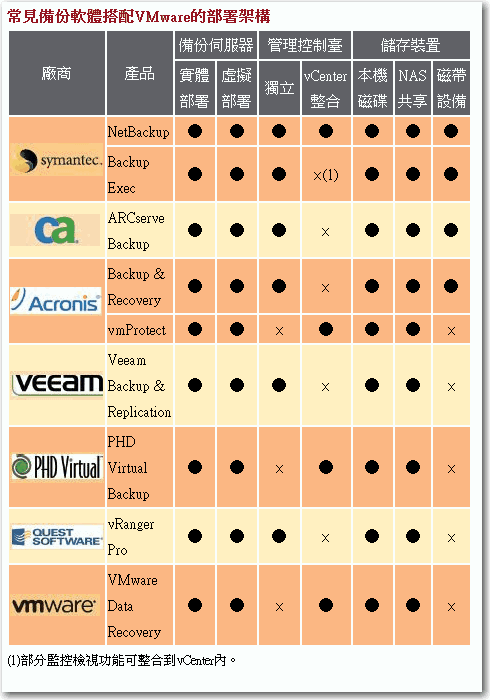
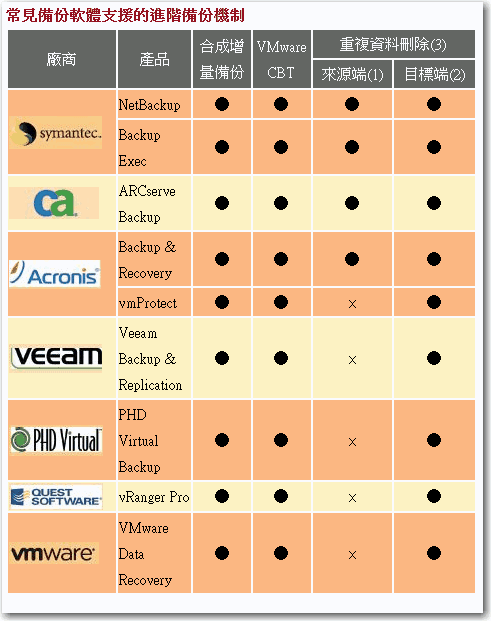
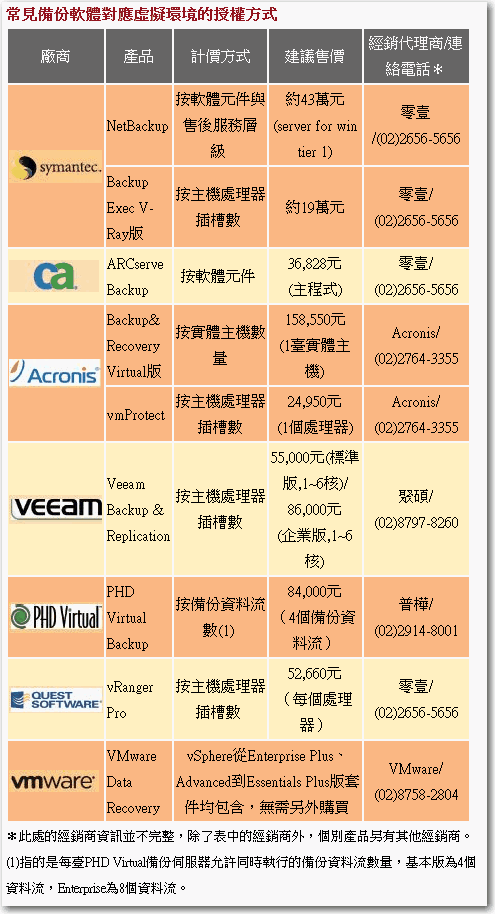
This latest brief review compared the pros and cons of the leading backup vendors for VMware ESX. (In Chinese).
It only touched the surface, not technical oriented and in fact not detail at all, sounds more like a marketing material to me.
我總覺得攝影就是簡單地把自己那一刻的感覺捕捉下來,什麼學院派攝影技巧都是其次。
這幅照片表達的就是這種與生俱來的感覺,面對諾大的紐約中央公園模特完全釋放自己的一剎那,攝影師Patrick Lichfield的靈感油然而生,然後喀嚓按下了快門,經典由此而生。

VMware ESX source code has been stolen and posted online, but the company said its virtualization platform doesn’t necessarily pose an increased risk to customers.
The stolen code amounts to a single file from sometime around 2003 or 2004, the company said in a blog post.
“The fact that the source code may have been publicly shared does not necessarily mean that there is any increased risk to VMware customers,” according to the blog written by Iain Mulholland, director of the company’s Security Response Center.
The code was stolen from a Chinese company called China Electronics Import & Export Corporation (CEIEC) during a March breach, according to a posting on the Kaspersky Threat Post blog.
The code along with internal VMware emails were posted online three days ago.
VMware didn’t respond immediately to a request for more information about the impact of the breach on customers.
Eric Chiu, president of virtualization security firm Hytrust, said it’s hard to say what VMware customers should do because there’s not enough detail about how the exposed code is being used in current products.
In general, though, customers should review the security for virtual environments to address the fact that a compromised hypervisor exposes multiple virtual machines.
While the incident is reminiscent of the breach last year of RSA source code, the circumstances differ. An RSA partner was breached and that breach was used to send a malware-laced email to an RSA staffer who opened it.
In VMware’s case, the CEIEC network was hacked and finding the source code was fortuitous.
This is what VMware posted in a blog: “Yesterday, April 23, 2012, our security team became aware of the public posting of a single file from the VMware ESX source code and the possibility that more files may be posted in the future. The posted code and associated commentary dates to the 2003 to 2004 timeframe.
“The fact that the source code may have been publicly shared does not necessarily mean that there is any increased risk to VMware customers. VMware proactively shares its source code and interfaces with other industry participants to enable the broad virtualization ecosystem today. We take customer security seriously and have engaged internal and external resources, including our VMware Security Response Center, to thoroughly investigate. We will continue to provide updates to the VMware community if and when additional information is available.”
Network World (US)
These treasure were from the past…used to be at least, now all went to recycle bin, probably will turn into a plastic cup later on.
Latest 12th generation Poweredge servers offers Express Flash PCIe SSD based solution for extreme high IOPS application. Available in Q2, 2012, now you can plug a total of four PCIe SSDs to the front of R720 (PCIe doesn’t support R720xd) and the PCIe SSDs are connected to the server board PCIe 2.0 directly. There is a cable directly connect to the on board PCIe from the backplane of the PCIe SSD tray as shown in H710p manual, more information can be found in PowerEdge R720/R720xd Technical Guide.
Btw, the only features difference between H710p and H710 are H710p has 1GB cache and supports CacheCade and FastPath where as H710 only has 512MB cache and does not support CC and FP.
This is the same case as in Poweredge R710 H700 raid card, CacheCade and FastPath are only supported with 1GB NV Cache version.

SEQUENTIAL I/O (not RANDOM) bandwidth is no longer limited by Perc Raid Card as the PCIe SSD becomes a system device now. This means you got to have a corresponding driver for the installed OS underneath, I checked VMware is on the list.
Hey, doesn’t this sound exactly the same as Fusion-IO?
The maximum bandwidth is up to 2GB/s for PCIe 2.0, 1.8GB/s for Read and 1.2GB/s for write as advertised by Dell for a single PCIe SSD. Well one thing I really don’t understand is, why Dell does not use the latest PCIe 3.0 connector which offers much higher bandwidth (3.2GB/s), it’s definitely strange!
In contrast, I can reach 1.3GB/s for Read and 1.2GB/s for Write (note both are sequential) as well using a consumer grade MLC based SSD (Crucial M4 128GB) through Perc H700 (that’s PCIe 2.0) on R710 anyway. Also for Random IOPS, I can reach 55,000 IOPS easily as advertised by Crucial, so what’s the point using PCIe SSD after all?
After reading the white paper Optimizing SQL Server Storage Performance with the PowerEdge R720, I figured out these new PCIe based SSDs (175GB and 350GB) are much more reliable now with SLC NAND (I smell $$$) and they required Perc H710P (I thought it’s not using the raid card anymore). In additional, One PCIe SDD drive resulted in 10.5x more IOPS (note Random) than 16 HDDs 10K array, that simply means a single PCIe SSD is equivalent to 10.5 PS6000X or 168 10K RPM spindles, excellent, but sounds unreal to me. I couldn’t find 107,518 IOPS is based on 4k or 32k, if it’s 4k, my consumer grade Crucial M4 128GB is definitely a much cost effective solution, probably at only 1/30 the cost.

Also remember SSD performance will degrade over time due to excessive write cycle and if you stress test it over a very long period of time continuously (that’s over 24 hours), the IOPS will drop to 1/10 of it’s starting value. However a SAS 15K RPM raid EQL box will sustain all the way. (Please correct me if I’m wrong)
Finally, something related, the SSD Dell used in their latest Equallogic is Pliant based SSD (e-MLC NAND as well), but those are 400GB.
Micron Announces 2.5″ PCIe SSD for Enterprise
Micron has announced the first 2.5″ SSD which utilizes PCIe interface instead of the more common SATA interface. The 2.5″ form factor allows for easy serviceability because the drives can be placed into the front end of servers. Traditional PCIe cards are harder to service and are not hot-swappable, requiring the server to be powered down. Furthermore, using PCIe instead of SATA eliminates the bandwidth bottleneck that SATA produces, maximum of 6Gb/s (or 750MB/s) versus 32Gb/s (or 4GB/s) for PCIe 2.0 x8.
The drive is essentially a 2.5″ version of Micron’s P320h SSD, which Micron announced in June last year. Both use 34nm SLC NAND and are based on the same in-house controller. According to Micron’s specifications, the controller is actually one of the fastest to date – providing read speeds of up to 3GB/s and write speeds of up to 2GB/s (yes, with a big B, i.e. bytes). Random 4KB read performance maxes out at 750K IOPS, while random read tops out at 341K IOPS (700GB version).
However, keep in mind that the controller features 32 channels. 2.5″ SSDs typically utilize 16 NAND packages, which means only half of the available channels would be in use with Micron’s controller. Micron couldn’t provide us with any detailed specifications or performance figures yet as this announcement was for promoting the new interface, not the actual drive, so we don’t know how much the performance differs from the FHHL sized PCIe card. The capacities are a bit smaller at 175GB and 350GB and at least random write performance should be slightly lower than what the FHHL card offers, but it’s certain that this will be one of the fastest (if not the fastest) 2.5″ SSDs.
Micron is currently sampling interested customers and an actual product announcement is going to follow later this year with more specific performance details. No pricing has been revealed, but Micron hinted that the price of the FHHL card would be over $16 per GB, which works out to be $2800 for 175GB and $5600 for 350GB if the 2.5″ version is priced similarly.
Update April 13, 2012
英特爾週四(4/12)推出910系列固態硬碟(SSD)產品,具備400GB和800GB兩種容量,並支援PCIe技術,可適用於雲端運算、虛擬化和線上交易等資料中心的儲存需求。
新產品採用最佳化的多層單元(MLC) 25奈米快閃記憶體,可提供5年內每天10次完整的硬碟寫入,與前一代標準型MCL快閃記憶體產品相比,耐用性提升了30倍。
英特爾表示,910系列具備高效能、耐久和可靠等特性,是用來取代I/O密集硬碟的理想選擇。它容易安裝,且無需修改既有的伺服器設計,可適用於儲存需要高效能處理和存取的分層和快取檔案。一顆910 SSD可取代多顆15K RPM的硬碟,不僅能節省空間和功耗,還能提升儲存擴充性,並同時降低時間延遲。
這是英特爾900系列產品的擴展,首度推出支援PCIe技術的SSD。800GB容量產品的速度為2GB/s持續序列讀取和1GB/s序列寫入,以及180,000 4K 隨機讀取IOPS(每秒輸入輸出運作)和75,000 4K隨機寫入IOPS。
樣品現已開始提供,量產時程訂於今年中。400GB容量價格為1929美元,800GB為3859美元,均提供五年保固。
No wonder most of the data centers in Hong Kong had such problem yesterday morning, GFW again, yuck!
Yesterday is kind of strange, ping to Hong Kong IP remains as low as 9-15ms, but non of the TCP ports can be opened, including VPN or SSL, not even regular port 80.
I think it’s probably due to the recent power struggle in Mainland causing the Internet censorship to be upgraded at China Telecom’s backbone network.
Some mainland Internet users reported that they couldn’t access overseas Websites such as CNN and MSN as usual with tools that help get over the Great Firewall since 10:40am Thursday.
According to a Google+ post, a user suspected that the glitch was caused by various service providers’ recent firewall upgrade or a problem in China Telecom’s backbone network.
The glitch has gone reportedly after noon. None of the mainland ISPs has offered explanations or statements on the problem by far.